1 University of Milan2 University of Bologna3 University of Edinburgh4 Miniml.AI
The encoder, labelled context and decoder jointly determine what generalises. We change one component at a time, keeping the other components and evaluation fixed.
Abstract
Graph-to-table systems combine three design choices: an encoder that maps relational evidence to feature rows, a context constructor that selects labelled examples, and a tabular decoder. We investigate whether these components can be evaluated independently through matched comparisons that change one component while holding the rest of the pipeline and the evaluation constant. Across logistic regression, CATBOOST, and TABPFN-3 on CLUTRR, 57 GraphLog worlds, and 57 knowledge graphs, we show that conclusions about one component can change when the others change. On CLUTRR, absolute positional encodings maintain all distinctions among the evaluated queries and fit the short-path setting nearly perfectly; yet, they generalise worse than relation-count features because the supported prefix acts as a shortcut that breaks down on longer paths. On GraphLog, encoder preference depends on the decoder, while the relation-count representation degrades as CatBoost tree depth increases. Across different knowledge graphs, adding the frozen ULTRA score to local features is consistently useful, whereas adding local features to the score has a smaller and less stable effect. A pointwise TABPFN-3 readout using the full encoder underperforms native ULTRA on 48 of 57 datasets. These results show that encoder assessment depends jointly on context and decoder, while panel-level conclusions can also depend on evaluation and aggregation protocols.
What the experiments isolate
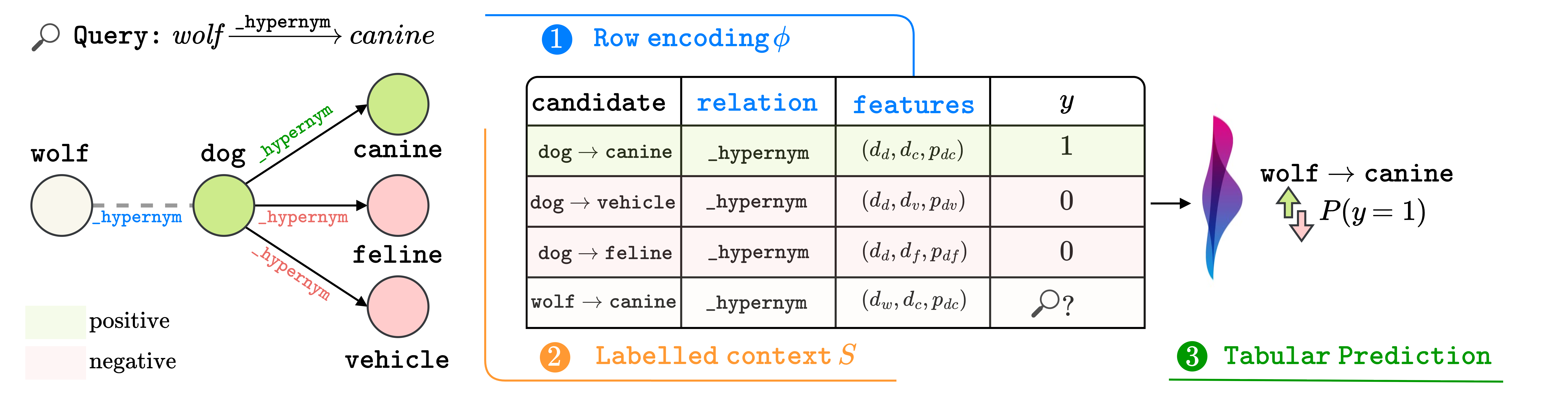
A graph-to-table system turns a relational query into a feature row, selects labelled examples, and asks a tabular model to predict. An end-to-end score mixes all three choices. A representation can retain the information needed for a task while exposing patterns that the decoder cannot learn from its available context.
We use matched comparisons that change one component at a time. Encoder comparisons share evaluation queries and context examples. Decoder comparisons share the same feature values before decoder-specific categorical encoding. Context interventions keep the encoder and evaluation fixed. The experiments cover short-to-long path transfer on CLUTRR and GraphLog, followed by candidate ranking across 57 knowledge graphs.
We also check what the rows can distinguish before fitting a decoder. If differently labelled queries collapse to the same row, a row-only predictor cannot separate them. When every evaluated row is unique, the ceiling is perfect even if the decoder generalises poorly. We report singleton mass alongside the ceiling and test transfer directly on CLUTRR.
Results
A supported prefix can obstruct length transfer
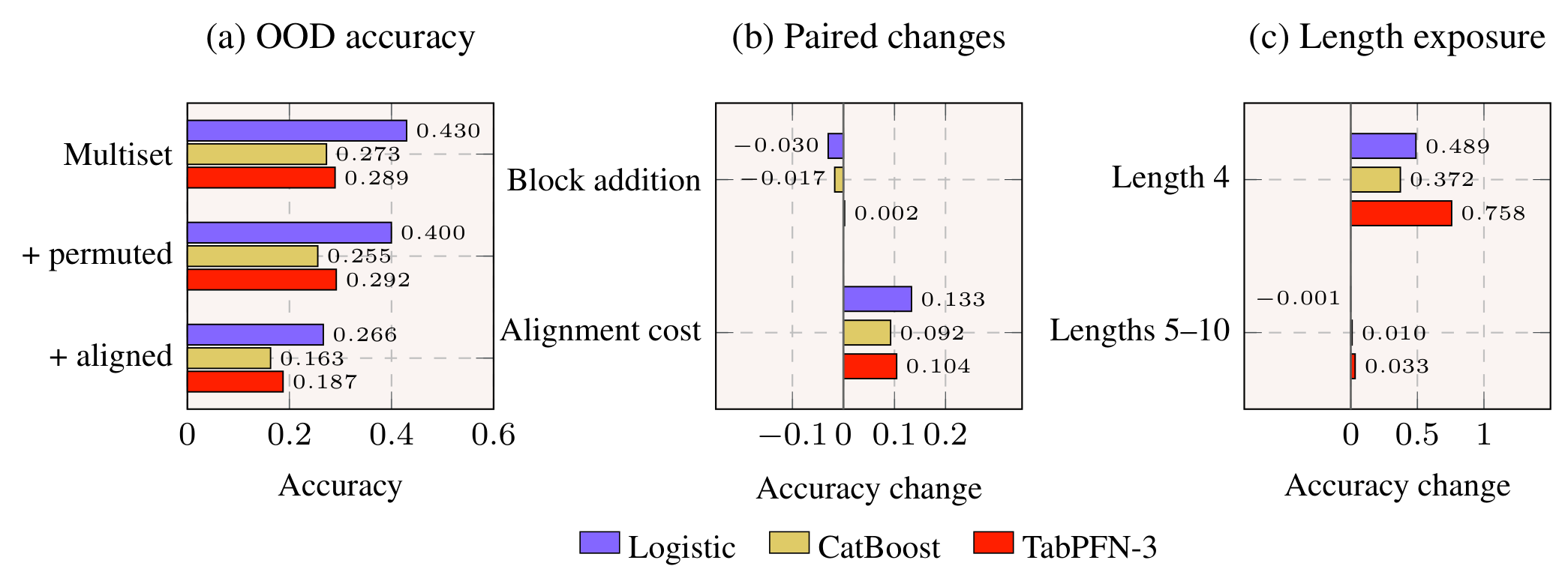
CLUTRR tests transfer from context paths of lengths 2–3 to evaluation paths of lengths 4–10. Absolute positions retain the relation at each position; relation counts discard that ordering. At 80 context examples per relation, TabPFN-3 reaches 28.9% accuracy with relation counts, versus 10.3% with absolute positions, even though every evaluated absolute-position row is unique. Accuracy is averaged equally over evaluation lengths 4–10, then over three paired context seeds.
To identify what causes the drop, we append a positional block to the count features and permute whole blocks among paths of the same length. Restoring the correct alignment keeps the block's dimensionality and collection of values unchanged, but costs TabPFN-3 another 10.4 percentage points. The harmful signal comes from how the positional features align with the query.
Figure 2. Path alignment and length exposure. Panels (a–b) use 80 context examples per relation, with context lengths 2–3 and evaluation lengths 4–10. Panel (c) holds the total at 100 examples per relation in both arms, replacing 20 additional short paths with length-4 paths. In (b), positive alignment values indicate accuracy lost when the correct alignment is restored.
The aligned encoders already fit 99.0–99.5% of the labelled context. Zeroing positions beyond the supported length barely changes predictions. Together, these controls support a shortcut explanation: the decoder learns a highly predictive short prefix that fails on longer paths.
Broader context helps locally. Replacing 20 additional short paths with 20 length-4 paths, at the same total budget, improves TabPFN-3 by 75.8 points at length 4, but only 3.3 points at lengths 5–10. A shared-parameter recurrent model reaches 70.5% overall accuracy at the largest budget, showing that substantially stronger transfer is attainable on this split.
Encoder preference depends on the decoder
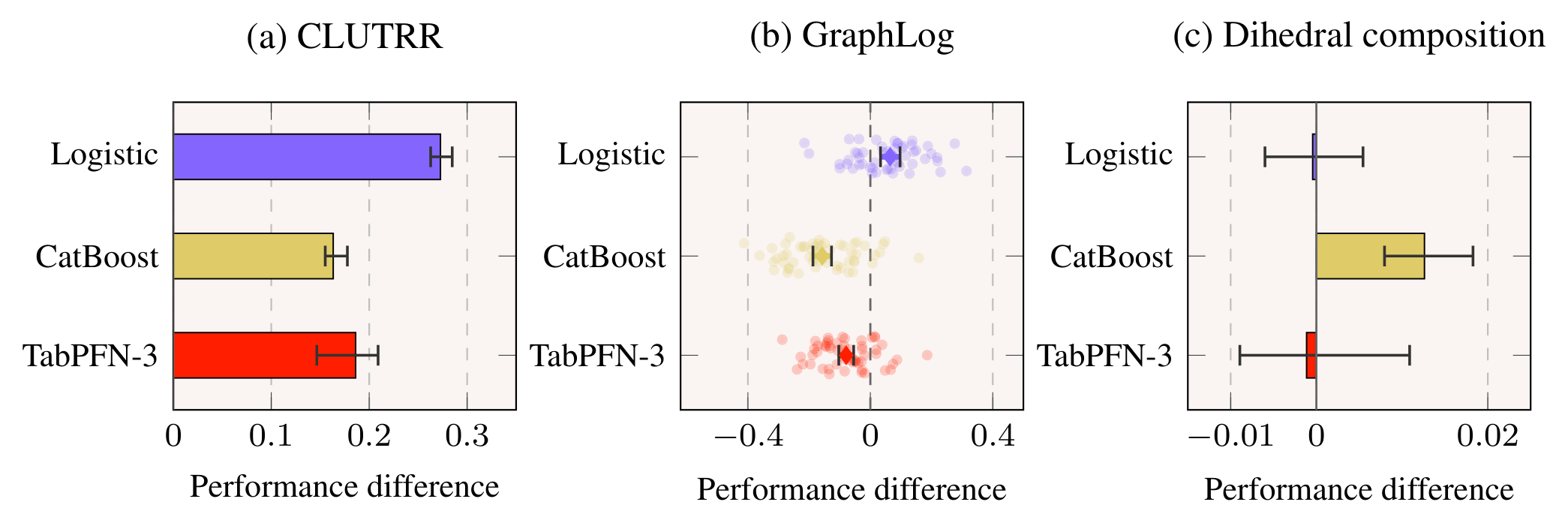
GraphLog's 57 worlds share a vocabulary of 20 directed relations while changing the relational rules. This fixes feature dimensionality and coordinate meaning across worlds. With the context and evaluation matched, relation counts beat absolute positions for logistic regression, but lose for CatBoost and TabPFN-3. The mean differences are +0.065, −0.157 and −0.079 in macro balanced accuracy.
This reversal is not explained by a wholesale loss of label distinctions. Both encoders retain high class-balanced ceilings. Yet the count representation is at or below each world's chance level in 30 of 57 worlds for CatBoost and 12 for TabPFN-3, compared with 1 and 4 worlds for absolute positions.
Figure 3. Encoder effects across decoders. Positive values favour the coarser encoder. GraphLog contrasts average equally over 57 worlds at 40 examples per class, with context lengths 2–3 and evaluation lengths 4–5. Points show worlds, diamonds show means, and capped intervals show sensitivity. The three panels use separate horizontal scales.
We also vary CatBoost tree depth while keeping the context, queries and remaining settings fixed. From depth 1 to 7, context macro balanced accuracy for relation counts rises from 83.0% to 94.8%, while evaluation macro balanced accuracy falls from 0.201 to 0.125. Both average equally over worlds; evaluation first averages equally over lengths 4–5. Absolute-position performance stays comparatively stable. Better context fit accompanies worse transfer for the count representation.
The dihedral control in Figure 3 gives a different result. Coarsening removes sequence order and merges task-relevant identities. Performance stays near chance. The useful representation depends on both which distinctions the task needs and how the decoder uses the available context.
The frozen score and local features contribute differently
In the knowledge-graph panel, each candidate triple becomes a row and the decoder ranks candidates for a missing head or tail entity. The Local encoder combines relation identity with endpoint, pair, path and community statistics. The Score encoder exposes only the score of the frozen graph-native ULTRA model.
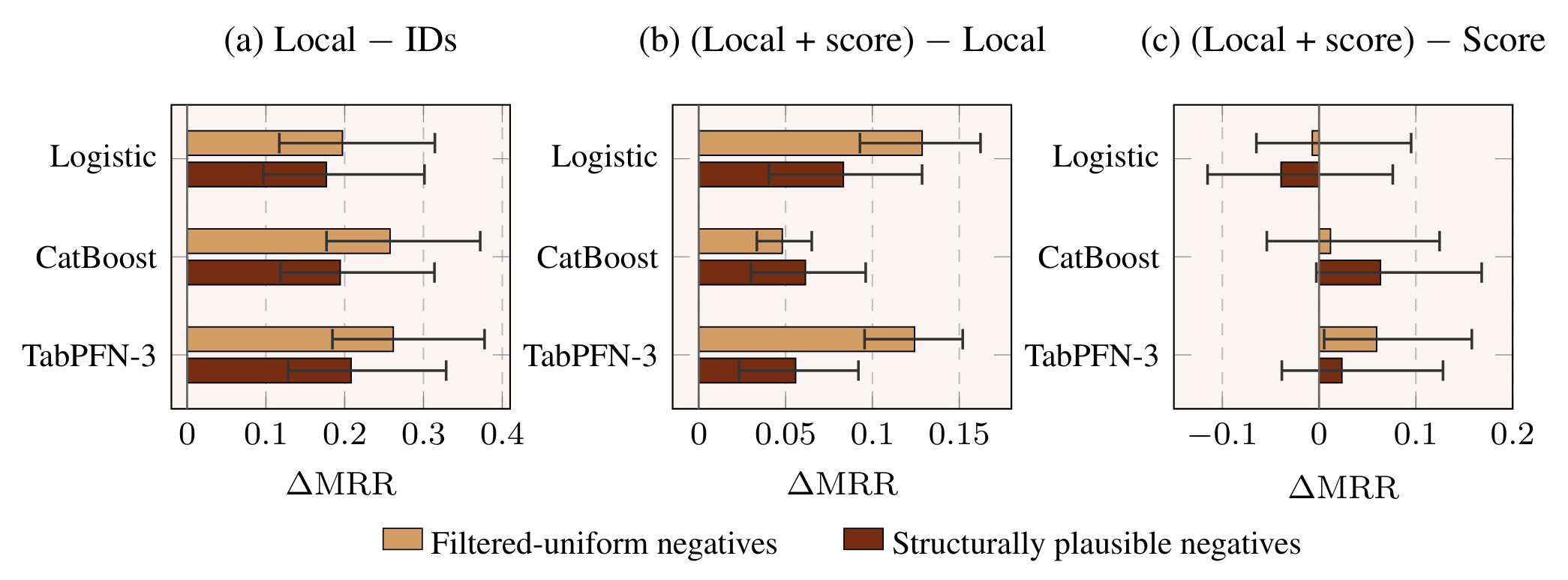
Adding Score to Local is consistently useful. It improves equal-family mean reciprocal rank (MRR) by +0.048 to +0.129 across the three decoders and two negative-context constructions. Five of six contrasts survive joint correction. The reverse addition, Local to Score, ranges from −0.039 to +0.064, and none of those six contrasts survives correction. The two feature blocks make markedly different contributions.
Figure 4. Feature additions across knowledge graphs. Equal-family effects over 57 knowledge graphs in 16 provenance families, at 200 examples per binary class. Light and dark bars distinguish filtered-uniform and structurally plausible negatives. Intervals show provenance-family bootstrap sensitivity. Each contrast adds a feature block to a matched tabular readout. We compare with native ULTRA rankings below.
The labelled negative context also changes performance. Replacing filtered-uniform negatives with structurally plausible negatives reduces MRR by 0.020 to 0.122 across all nine informative encoder–decoder combinations. The positive context and evaluation queries stay fixed, and negative selection uses graph-based criteria without consulting evaluation labels or the frozen score.
A separate control changes only the rejection of known positives and finds much smaller effects. The main drop remains after accounting for that filtering choice. Even with a fixed encoder, which labelled examples reach the decoder changes the measured result.
A tabular readout can lose a useful native ranking
The Full encoder combines Local, Global and the frozen ULTRA score. TabPFN-3 with Full underperforms native ULTRA on 48 of 57 datasets and 14 of 16 provenance families. The readout loses ranking performance even though its input includes the upstream score.
The aggregate comparison changes with the weighting. Full-minus-native MRR is +0.006 with equal weight per provenance family, but −0.035 with equal weight per dataset. Excluding MetaFam yields −0.041 under equal-family aggregation. A positive family average can coexist with losses on most datasets.
Score-only logistic regression preserves native ULTRA ranks exactly across all 684 dataset–budget–seed combinations. Adding global topological features to Local plus Score changes TabPFN-3 MRR by only +0.005, with sensitivity interval [−0.001,+0.010] and no support after joint correction. The native ranking is an essential reference whenever that score enters the table.
Different queries need different graph evidence
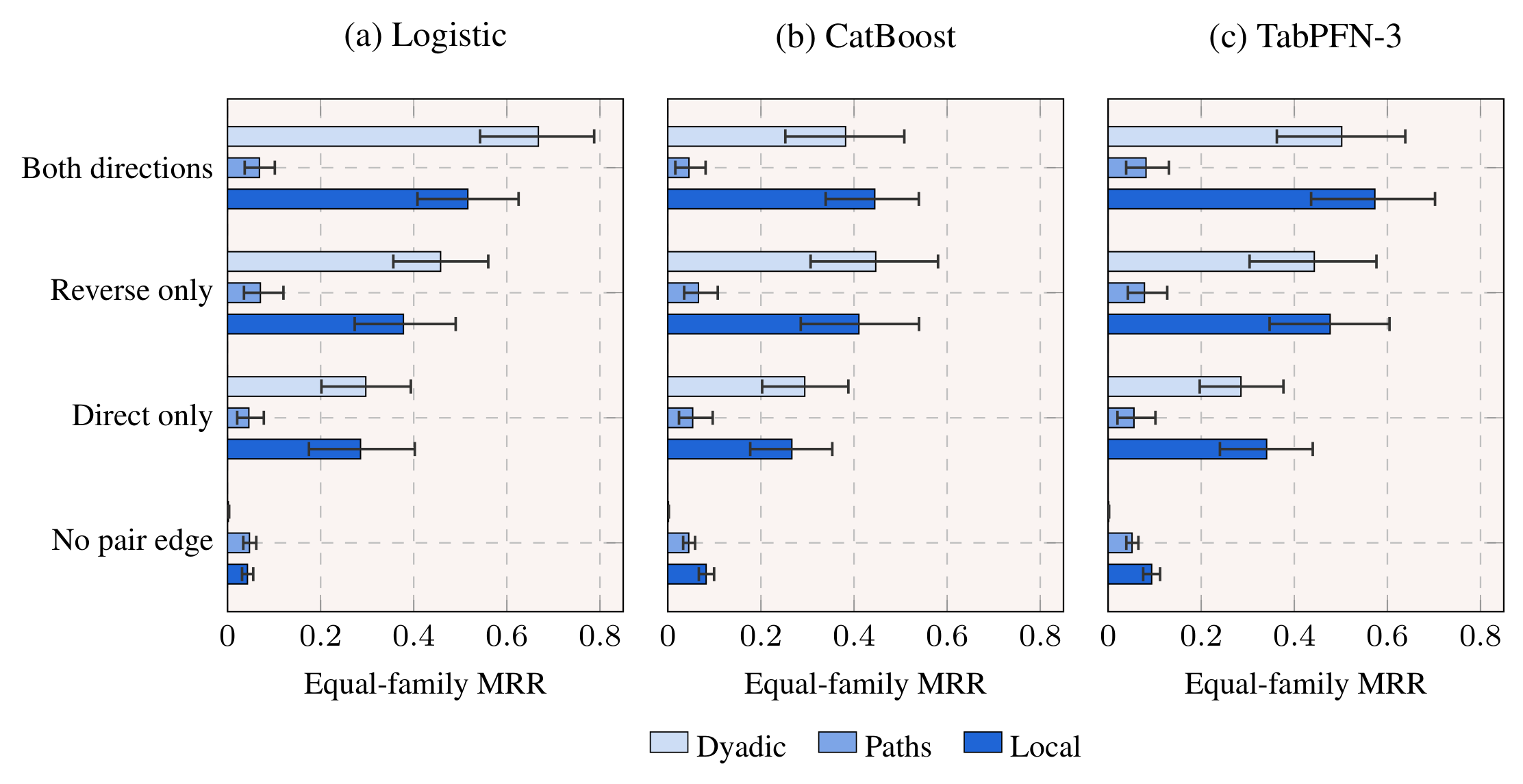
Aggregate MRR hides a second distinction. Among 7,296 directional queries, 1,622 have an observed direct or reverse edge of another relation between their endpoints. The other 5,674 queries lack such other-relation pair evidence. This connectivity is measured in the support graph, excluding the target relation.
Features of the endpoint pair, called Dyadic, outperform bounded-path features in each endpoint-connected group. The ordering reverses when other-relation pair evidence is absent. Within that group, equal-family MRR across decoders is only 0.001 to 0.002 for Dyadic, compared with 0.045 to 0.052 for Paths and 0.043 to 0.094 for the broader Local encoder. We average within each query group, giving each provenance family equal weight.
Figure 8. Reciprocal rank by observed endpoint connectivity. Each panel uses a different decoder on the same 57-graph panel. Bars report equal-family MRR for Dyadic, Paths and Local features within each query group; intervals show provenance-family bootstrap sensitivity.
This explains why a feature set that works well on connected pairs can be inadequate for most queries. Reporting the query mix is part of explaining the encoder's performance. The stratified comparisons use the same queries, candidate sets and evaluation protocol, so the differences are visible without changing the ranking task.
Alignment and ranking difficulty
We test the alignment control on generated tasks and examine why knowledge graphs differ in ranking difficulty.
The alignment control recovers known relational evidence
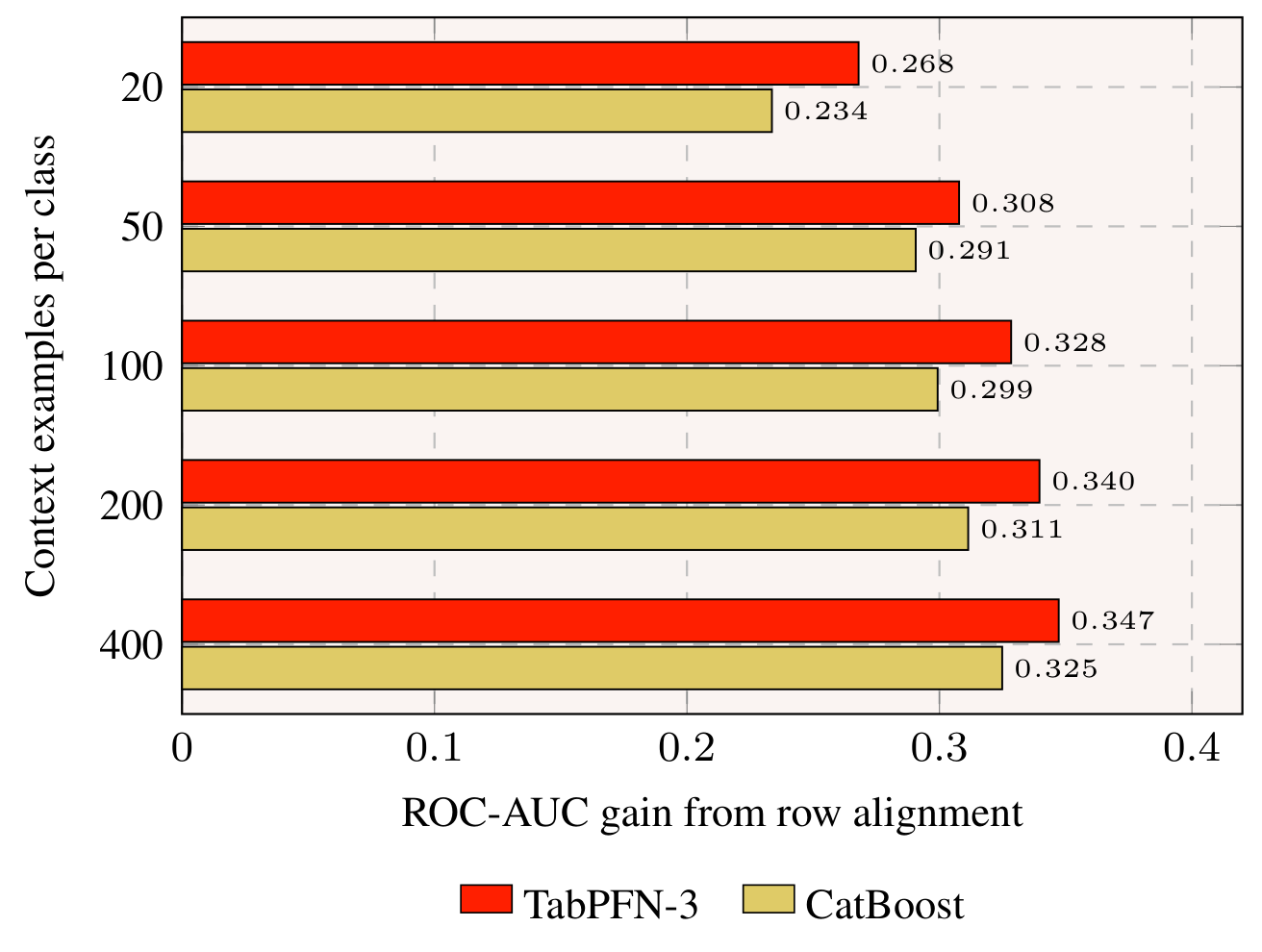
We generate tasks governed by reciprocity, typed composition, structural roles and shared community membership, with disjoint context and evaluation graphs. Correctly aligned evidence becomes more useful as the labelled context grows. Jointly permuting complete feature rows preserves the block's dimensions and covariance but breaks its correspondence to each query. Under this permutation, ROC-AUC stays between 0.497 and 0.508, close to chance.
Figure 6. Alignment across context budgets. Bars show equal-property macro ROC-AUC gains over the joint row-permutation control, averaged over ten regenerated graphs per property. The control separates useful query-aligned evidence from merely adding columns.
Context separation and candidate count track shared difficulty
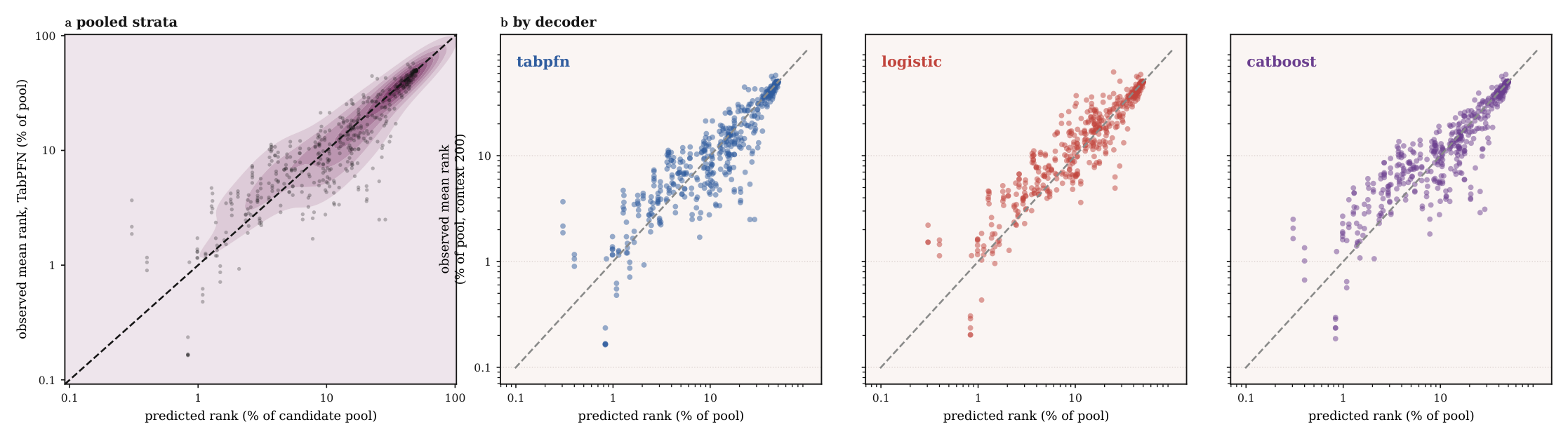
A simple context-based heuristic combines the strongest single-column separation of positive and negative examples with the size of the candidate pool. Without refitting, it orders observed TabPFN-3 mean rank with Spearman correlation 0.957 across 455 dataset–encoder strata at 200 examples per class. The same broad relationship appears for logistic regression and CatBoost.
The heuristic tracks which dataset–encoder combinations are difficult across decoders. Leave-one-family-out selectors do not improve on their in-fold majority baseline.
Figure 10. Context-predicted versus observed rank. Ranks are expressed as a percentage of the candidate pool on logarithmic axes. Panel (a) summarises TabPFN-3 strata; panel (b) separates the three decoders. Dashed diagonals mark equality.
One frozen score is often the strongest individual column
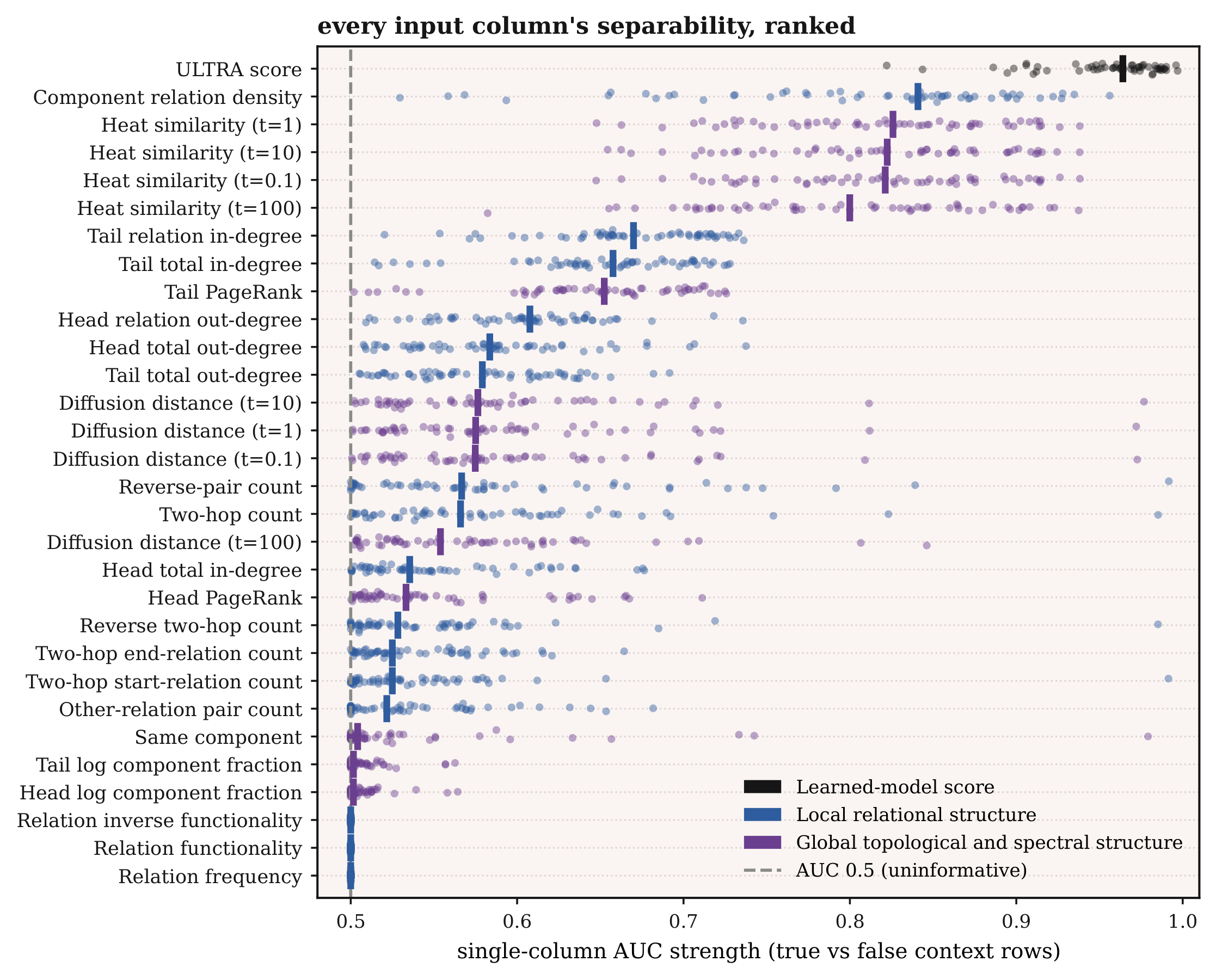
The frozen ULTRA score is the strongest single-column context separator on 55 of 57 knowledge graphs. Most constructed local and global columns lie closer to chance. This helps explain the consistent gains from adding the score to local features. The matched block-addition experiments above measure what the remaining features contribute alongside it.
Figure 11. Single-column context separability. Each point is one knowledge graph at 200 examples per class; heavy ticks show column medians. Columns are ordered by median oriented ROC-AUC, with chance separation at 0.5.
How to compare graph-to-table systems
Separate retained information from learned transfer. Report row collisions and singleton mass, then test alignment and context support. A perfect row ceiling and near-perfect context fit can accompany poor extrapolation.
Cross the encoder with the decoder and context. GraphLog changes the preferred encoder across decoders; the knowledge-graph experiments change performance through the negative context alone.
Keep native rankings and aggregation visible. When importing a pretrained graph score, compare against its original ranking. Show dataset and family summaries alongside query-connectivity strata.
The knowledge-graph results use one frozen ULTRA checkpoint, whose pretraining lineages overlap part of the panel. Bootstrap intervals describe sensitivity to the composition of this fixed panel. Leaving out one family at a time shows how much the aggregate depends on individual families.
Code and reproduction
The repository includes feature construction, context generation, decoder evaluation and verification of bundled reference outputs. The reproduction guide separates checking the release artifact from rerunning experiments. Full reproduction requires the external datasets, checkpoints and generated assets listed there.
Citation
@misc{cagiano2026graphtotableinterfacescontrolrelational,
      title={Graph-to-Table Interfaces Control Relational Generalisation},
      author={Alessandro Cagiano and Lorenzo Molfetta and Gianluca Moro and Matteo Zignani and Pasquale Minervini},
      year={2026},
      eprint={2610.25993},
      archivePrefix={arXiv},
      primaryClass={cs.LG},
      url={https://arxiv.org/abs/2610.25993},
}